
Designing for 120M+ Users: Solving the Social Friction of Fair Bill-Splitting in India
Using OCR and QR flows so users only pay for what they consumed and settle debts instantly.
Type: B2C
Industry: Fintech
Scope: Research → Full-Cycle UX/UI → Usability Testing (𝑛=16) + Heatmap Analysis
My Role: End-to-end ownership, user research (surveys & interviews), UX strategy, final UI design, and usability testing
TL;DR
Problem

Most bill-splitting apps force a trade-off: users must choose between an unfair 'even split' or a labor-intensive manual entry for item-based split
Solution

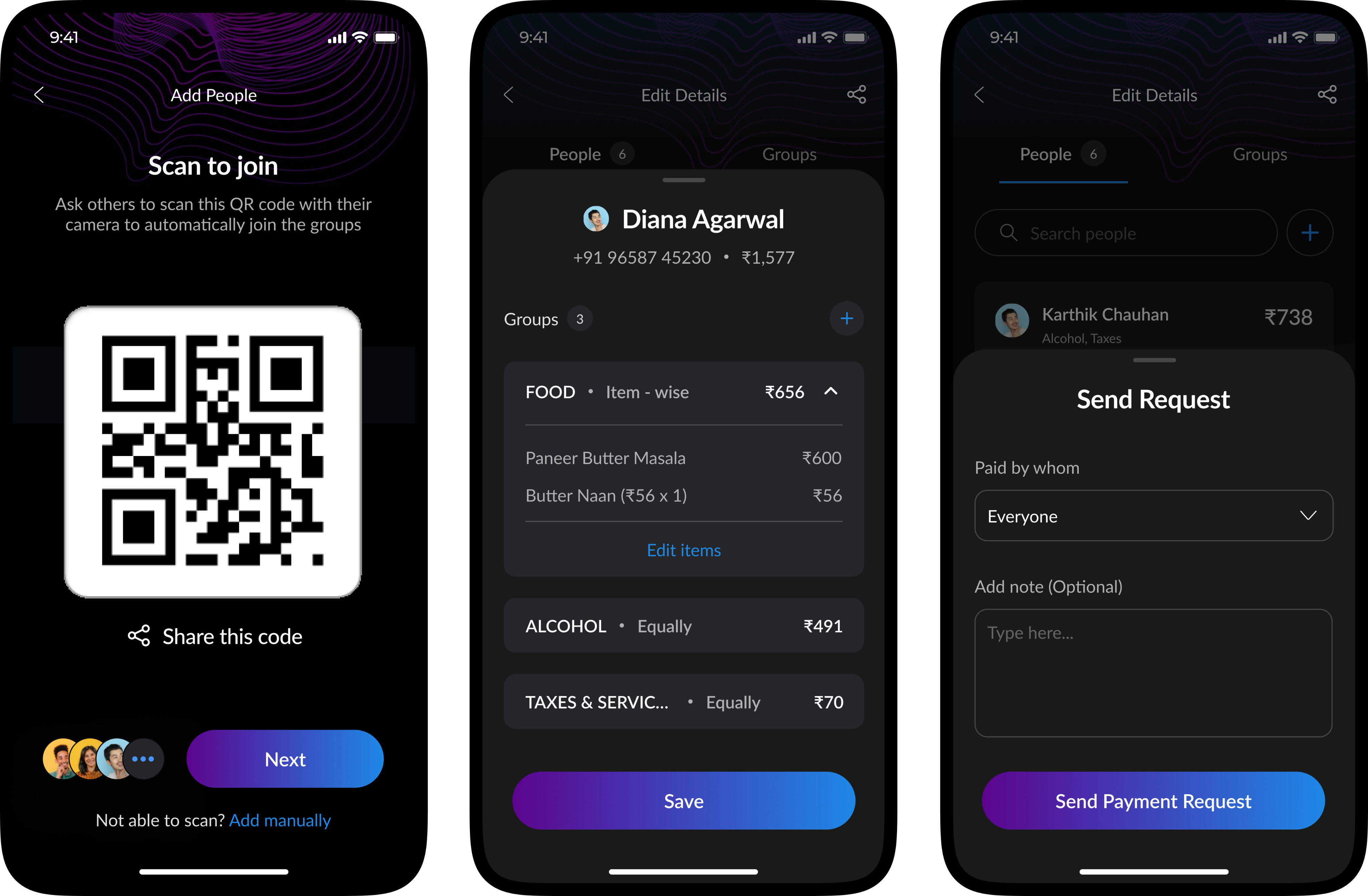
By combining OCR bill scanning with a QR-triggered web flow, participants can instantly join and assign their own consumption
Intended impact

- Faster Time-to-Payment: Instead of waiting until everyone gets home to 'figure out the bill' (which leads to forgotten debts), users assign and verify their shares in the moment
- Lower Interaction Cost: OCR turns a 5-minute manual typing chore into a 5-second "scan bill & verify" step, drastically reducing the cognitive load for the host
- Increased Long-Term Retention: Users return to a product that solves social friction
The Approach
01

Identifying the Friction
Conducted 6 user interviews + survey responses to understand how groups currently settle bills and where friction emerges
02
Simplifying the Logic
Explored multiple splitting models to evaluate cognitive load and decision clarity
03
Perfecting the Payment Flow
Conducted usability testing on key flows (scan → assign → validate → trigger payment)
SCOPE
Market Size in India (2026)
With over 21 billion monthly UPI transactions, urban Indians are ready for a digital-first solution that eliminates the 'social tax' of manual bill splitting.
*Sources: NPCI Digital Payment Dashboard (2026), UN Population Fund India, Redseer Gen Z Spending Report, and Deloitte TMT Predictions 2026.

Target Audience
Focusing on 120M+ urban social spenders who prioritize total financial precision and seamless, app-free digital payments

RESEARCH & DISCOVERY
Studying the "Social Split" Conflict
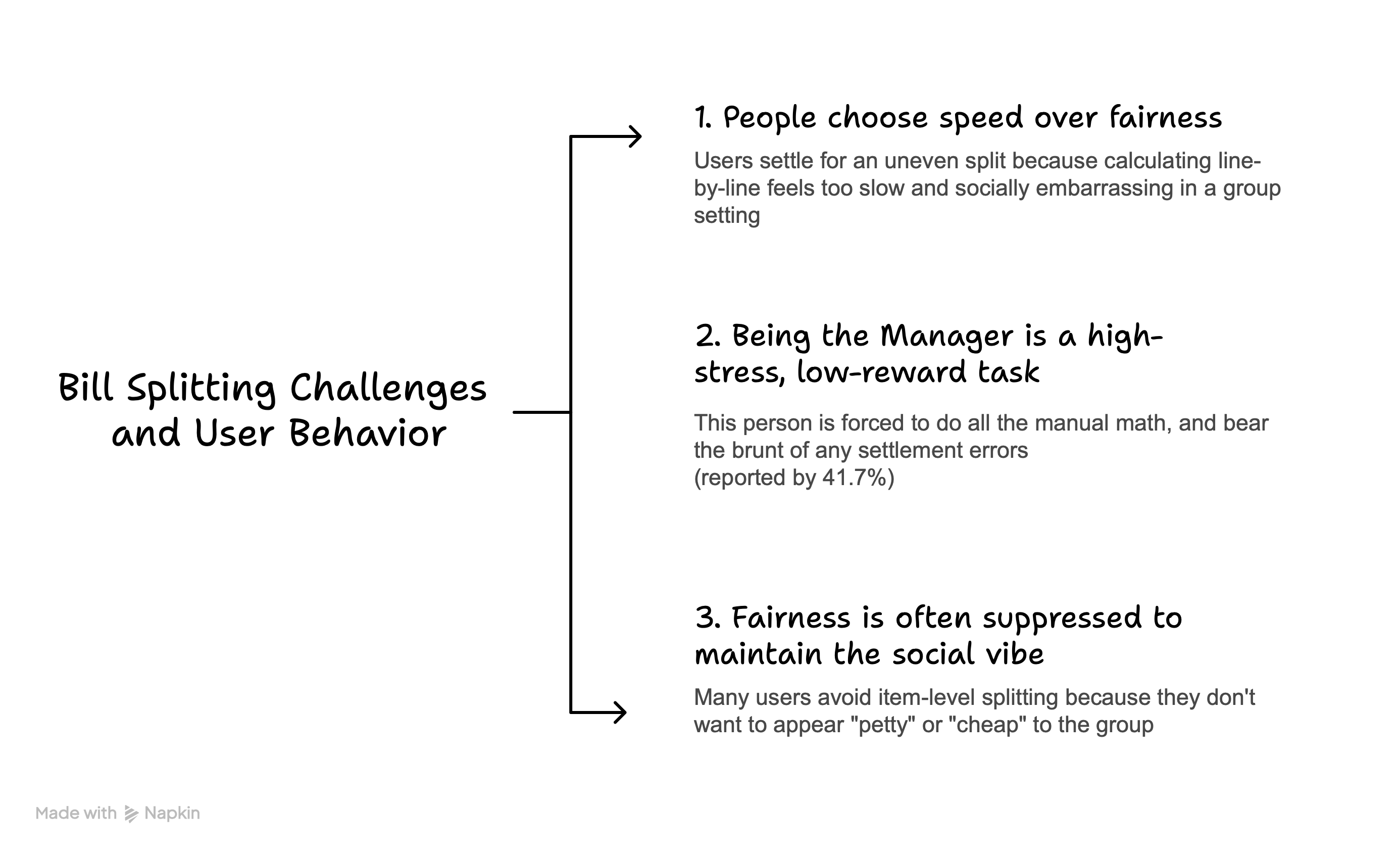
A survey of 12 frequent splitters and 6 deep-dive interviews revealed that while users value fairness, the "math friction" at the table forces them into poor financial habits.
“Equal split” remains the behavioral default
58.3%
Usually split bills equally despite uneven consumption
66.7%
Feel uncomfortable paying for items they didn’t consume
Users still do the “manual math”
58.3%
Rely on manual calculation instead of apps
41.7%
Reported confusion or mistakes during settlement
In users’ words
“The idea that everyone is comfortable with the way you are sharing the bill makes the process easier, because even if one person doesn't like the way, there is a problem.”
- Participant, Associate Lawyer
“If I go out often, then I definitely care about alcoholic and non-alcoholic split… I may have to pay for what I had.”
- Participant, Student
COMPETITIVE ANALYSIS
Why existing splitting apps create settlement friction
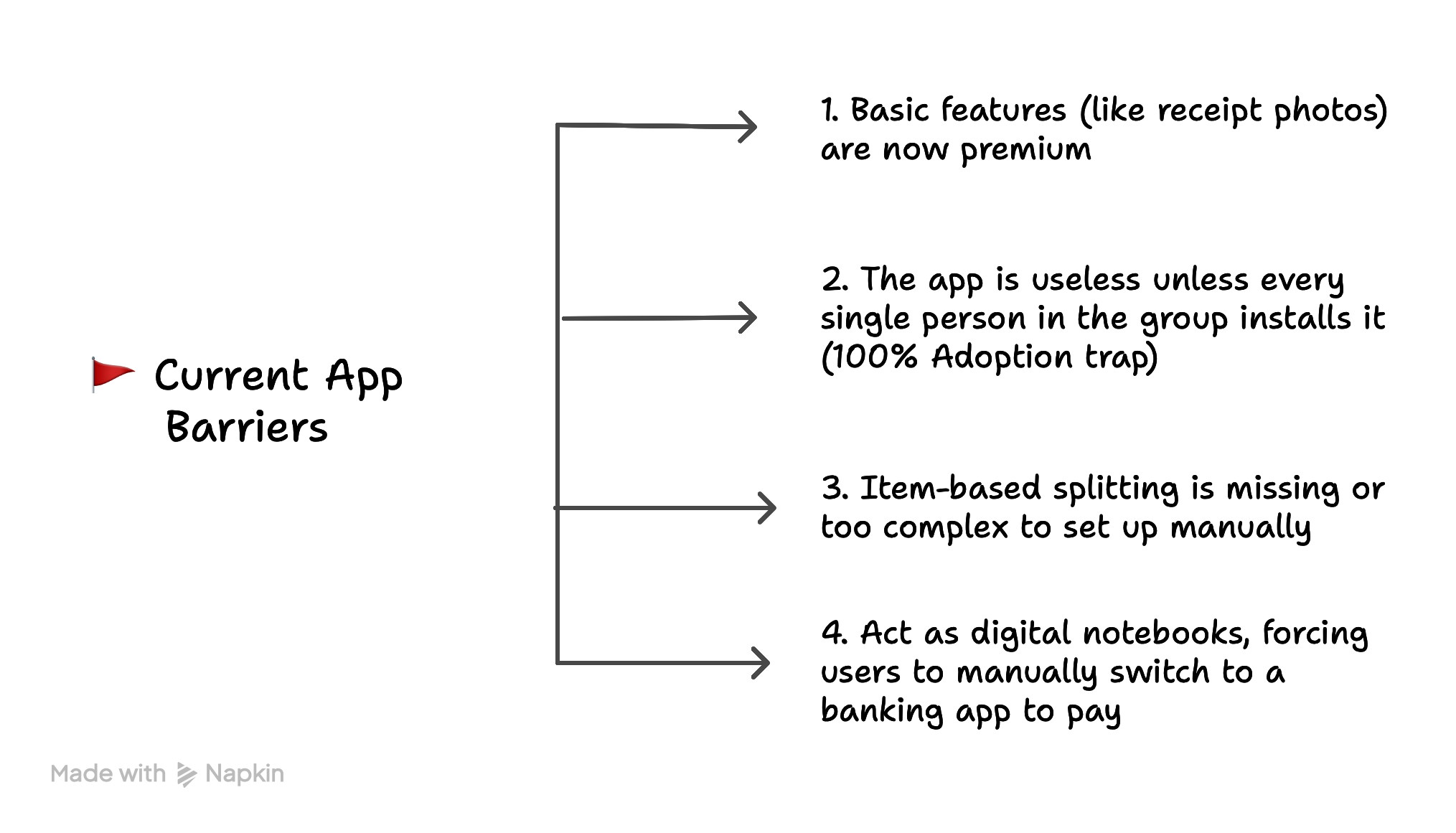
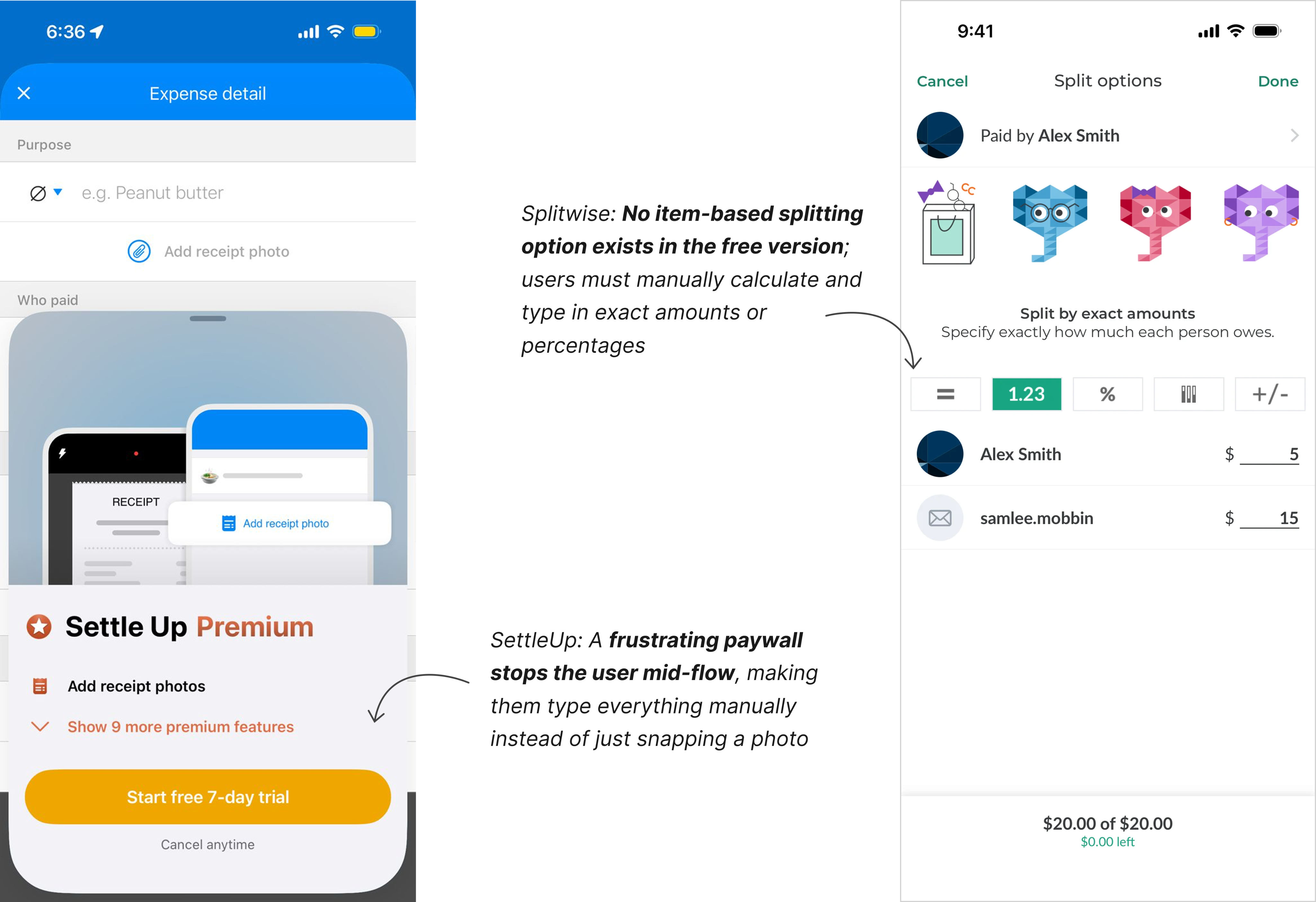
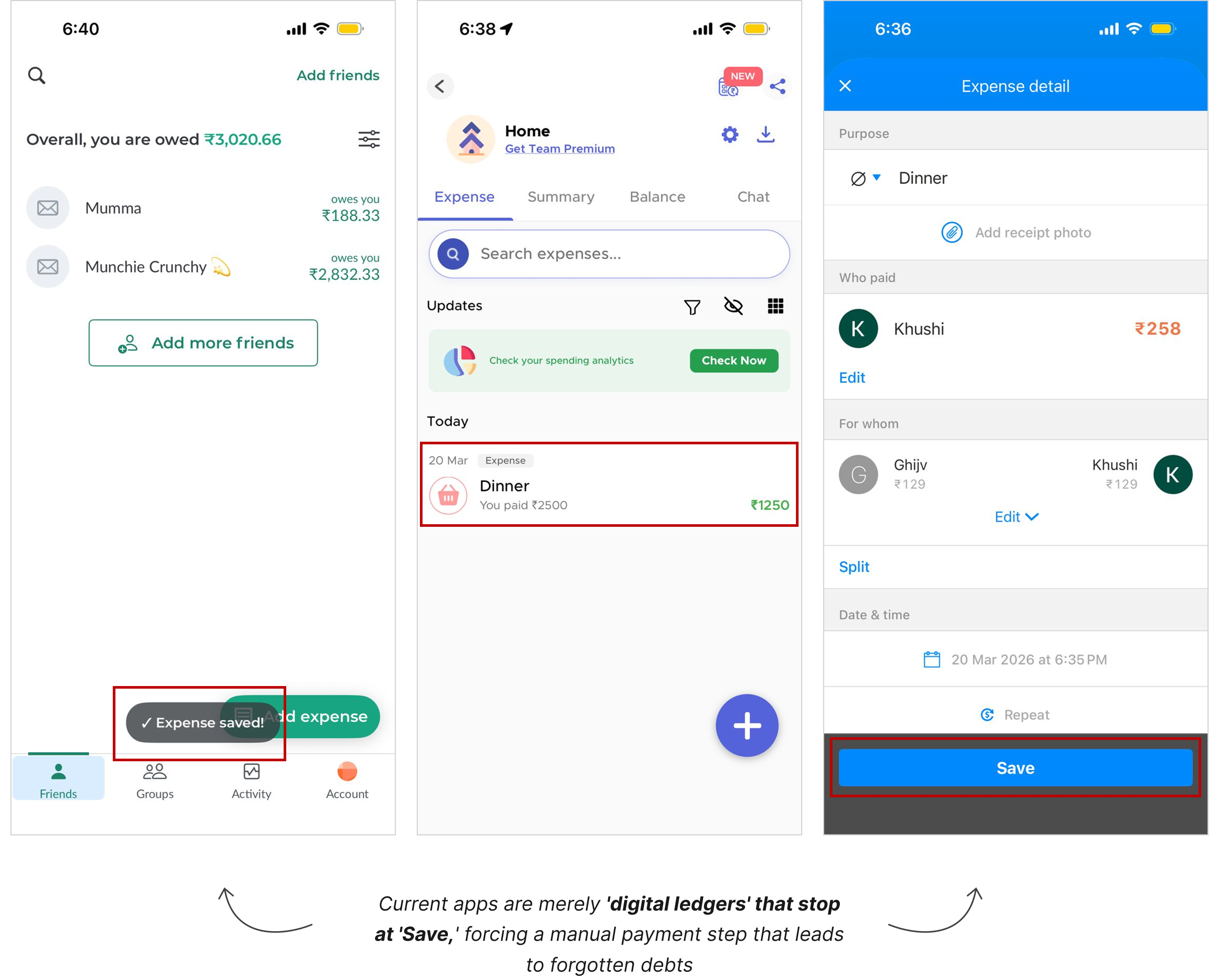
I evaluated the three most common split apps (Splitwise, SettleUp, SplitKaro) and found that they all suffer from a "Manual Reconstruction" problem. Instead of simplifying the process, they add extra layers of digital chores
Some examples from the market
Even major apps like Splitwise lock item-based splitting behind a $5/month paywall, leaving free users stuck with manual math
PROBLEM
Accurate Splitting is a Manual Chore
Most bill-splitting apps force a trade-off: users must choose between an unfair 'even split' or a labor-intensive manual entry for item-based split (if available)
Impact
⚠️ High Interaction Cost
Typing 15+ items into an app takes 5+ minutes, leading to extensive manual labour
⚠️ High Task Abandonment
Forcing every guest to download an app and create an account kills the momentum of instant payment
⚠️ Increased Time-To-Payment
By stopping at 'Save,' current apps create a 'Settlement Gap' that kills payment conversion and leaves debts unpaid for days
THE NEW USER FLOW
The 'Scan-to-Settle' Direct Flow

IDEATIONS
Finding the Right Flow
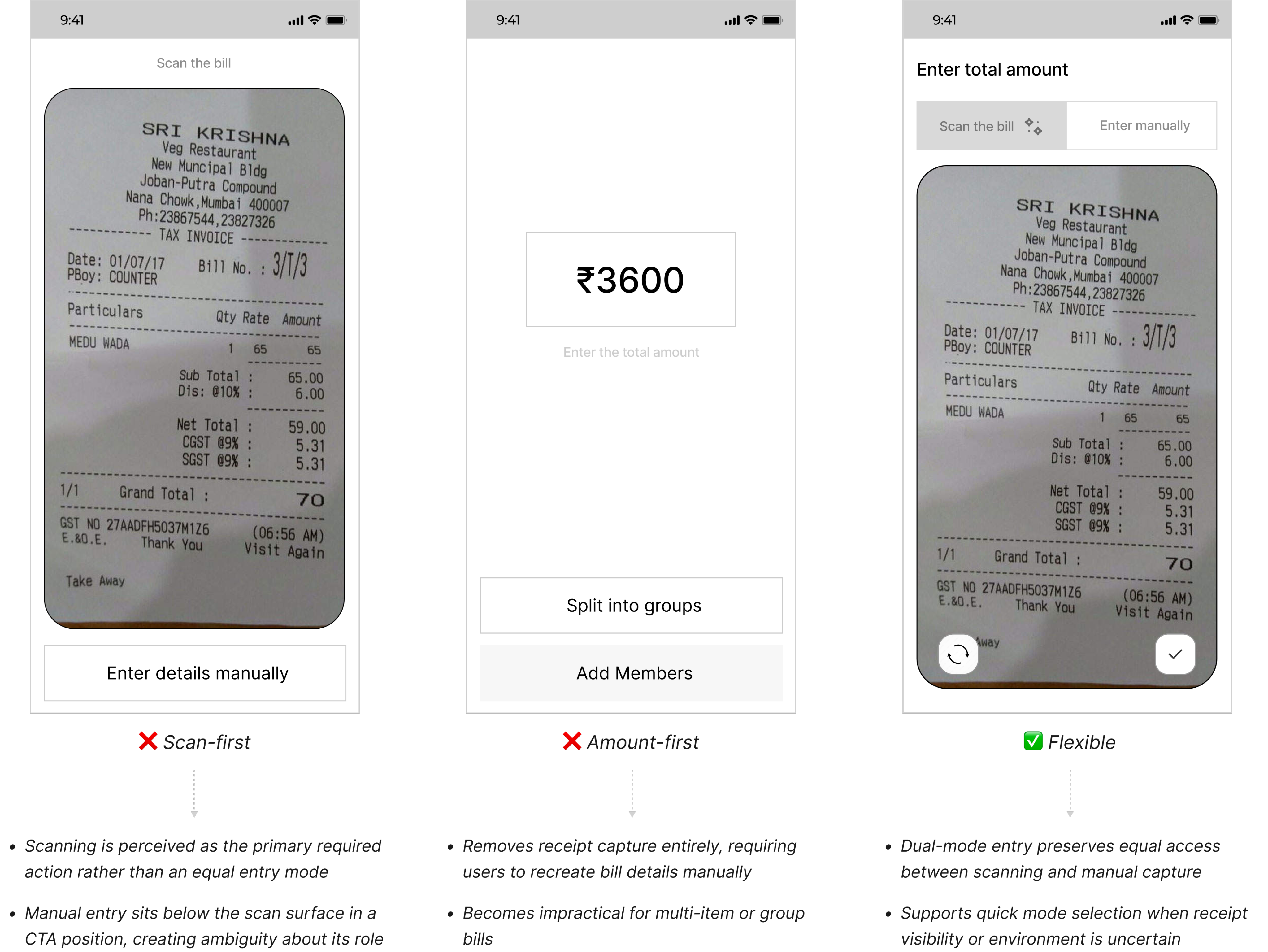
➡️ How do we handle the chaos of a real restaurant (Low light, bad camera, loud environment)?
Users often split bills in low-attention social contexts, where scanning may be slow or unclear
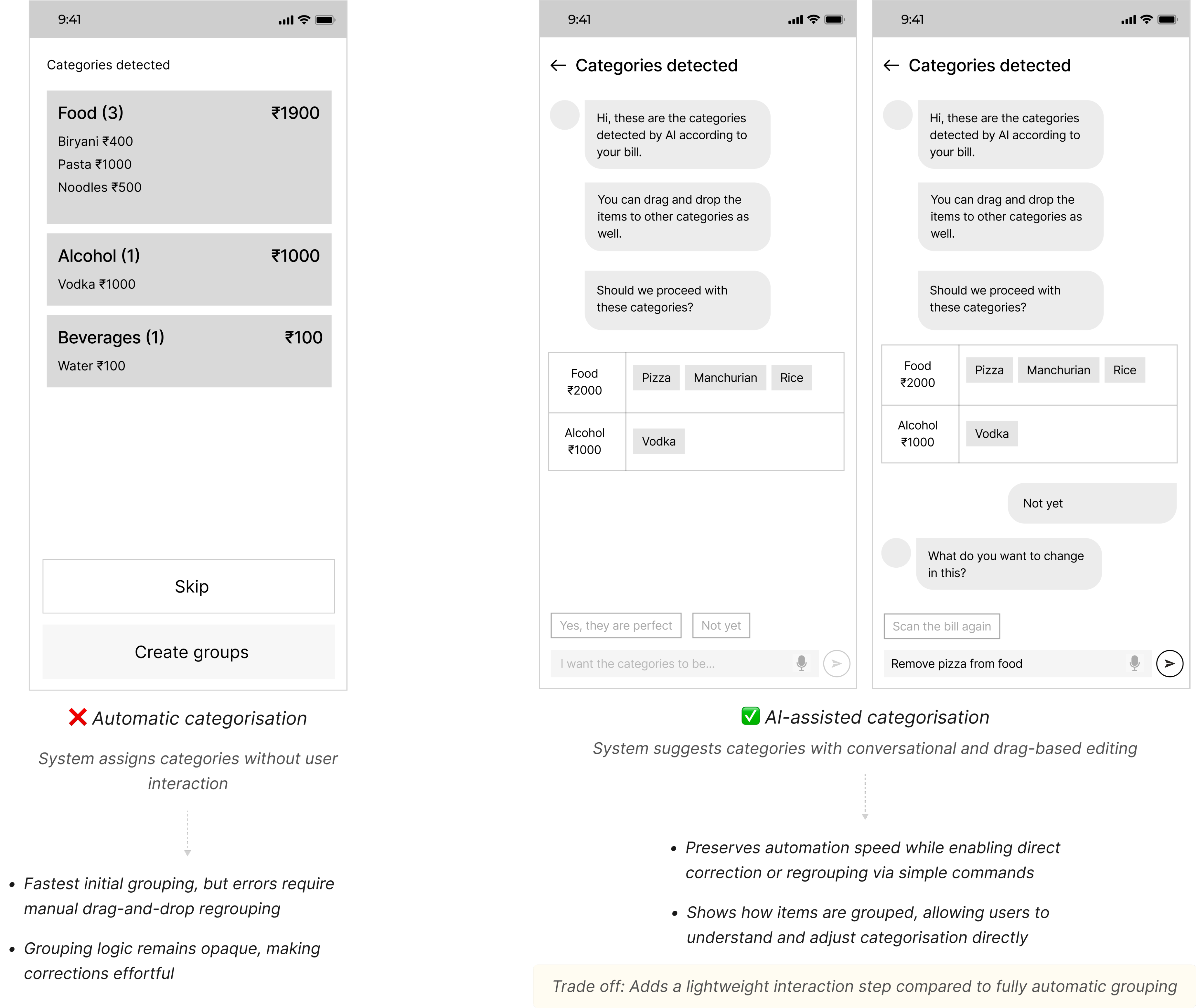
➡️ What happens when the AI gets it wrong?
Instead of fully automatic grouping, I chose AI-assisted editing so users can quickly fix errors without feeling stuck.
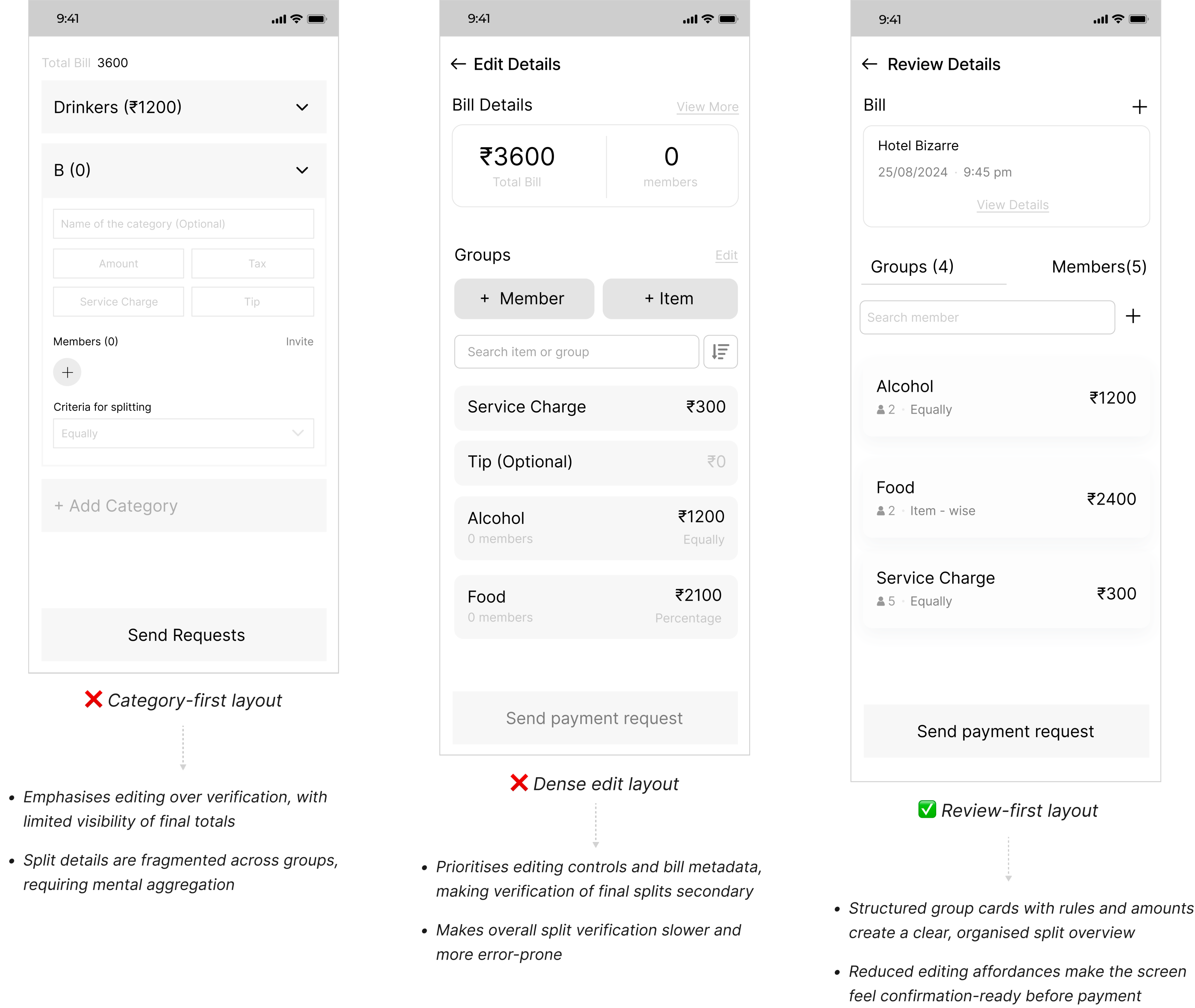
➡️ How do we build trust before the final request?
nstead of cluttering the final step with editing tools, I prioritized a structured summary so users can verify totals at a glance before sending requests.
FINAL DESIGN
Bridging the Settlement Gap
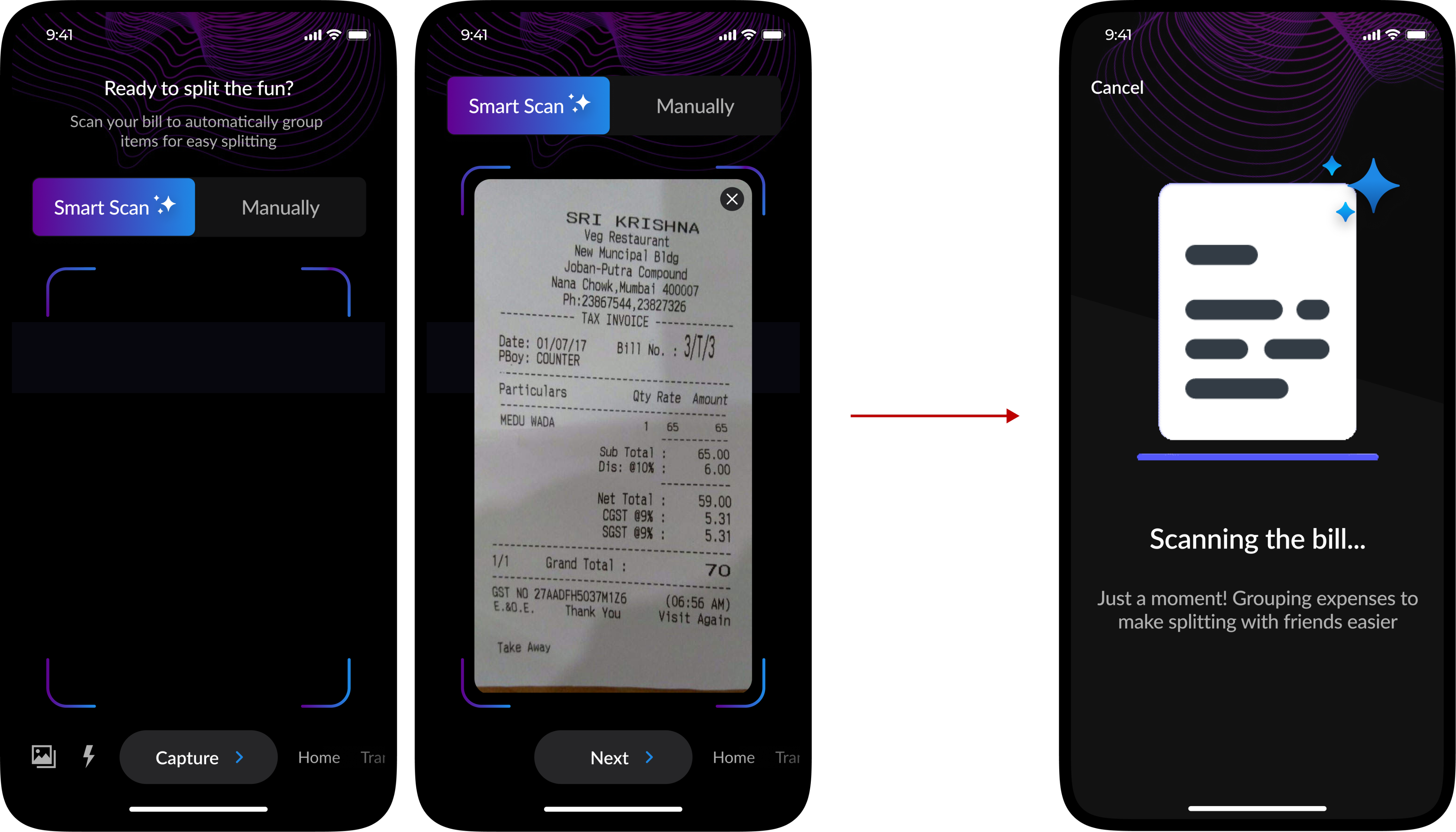
Step 1: Automated OCR Data Extraction
Eliminates the "Manual Entry Tax." Users get the fairness of item-based splitting with the speed of an equal split.
Reduces interaction cost of manual data entry by 90%
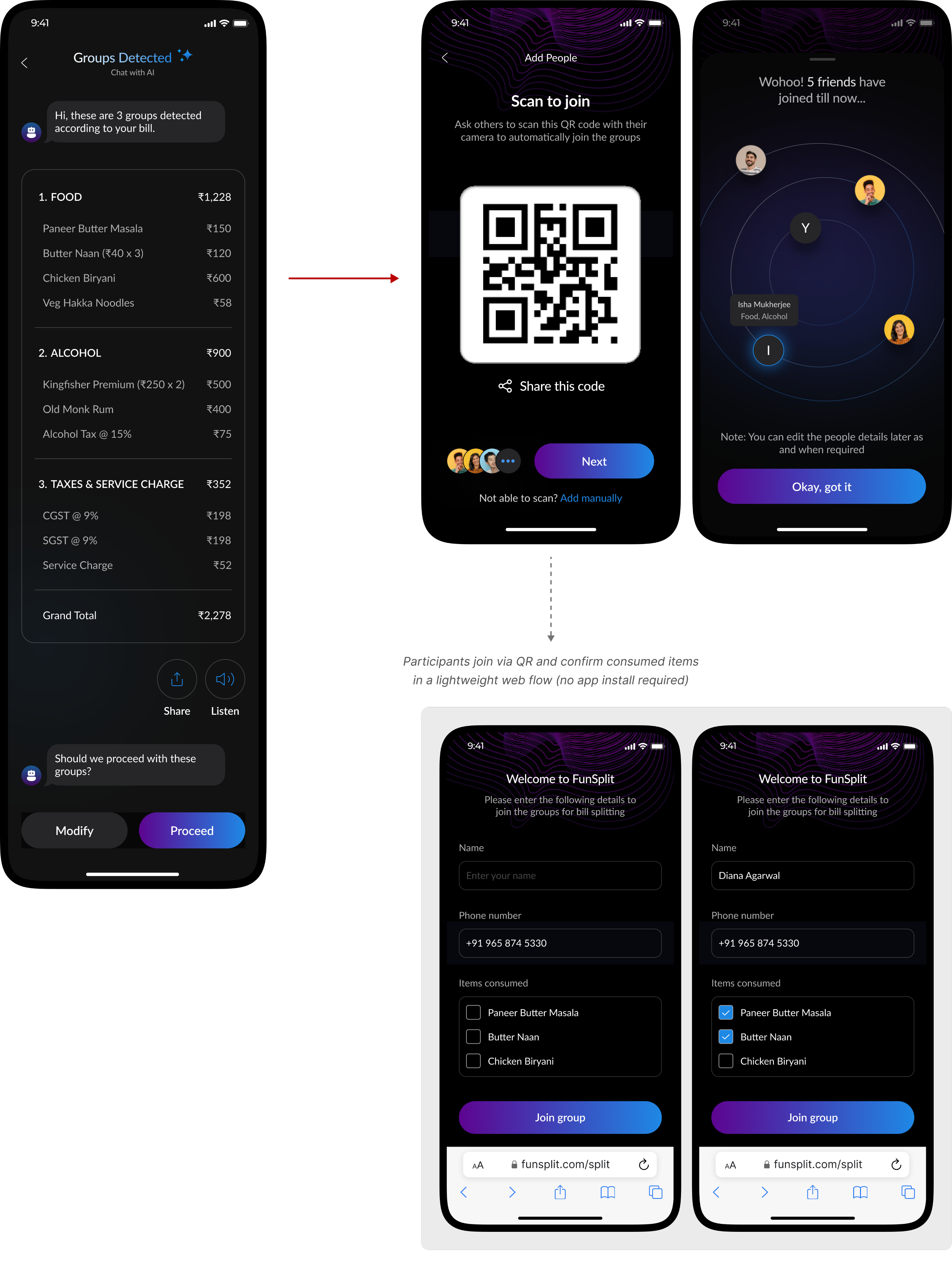
Step 2: Frictionless Web-Join Flow
Eliminates the "App-Store barrier" by allowing guests to join instantly via a browser rather than the mandatory download and sign-up phase.
- Low Task Abandonment: Eliminates drop-off due to mandatory app downloads or forgotten passwords
- Higher Task Success Rate: The process of allocating consumption for each user is significantly faster than market standards
Step 3: Live-Sync Settlement
Total transparency. When a user sees their exact consumption confirmed by the host, the "Time-to-Payment" accelerates.
Accelerated Time-To-Payment: Prevents the awkward "Wait, why is my total so high?" conversation, ensuring a successful payment rate
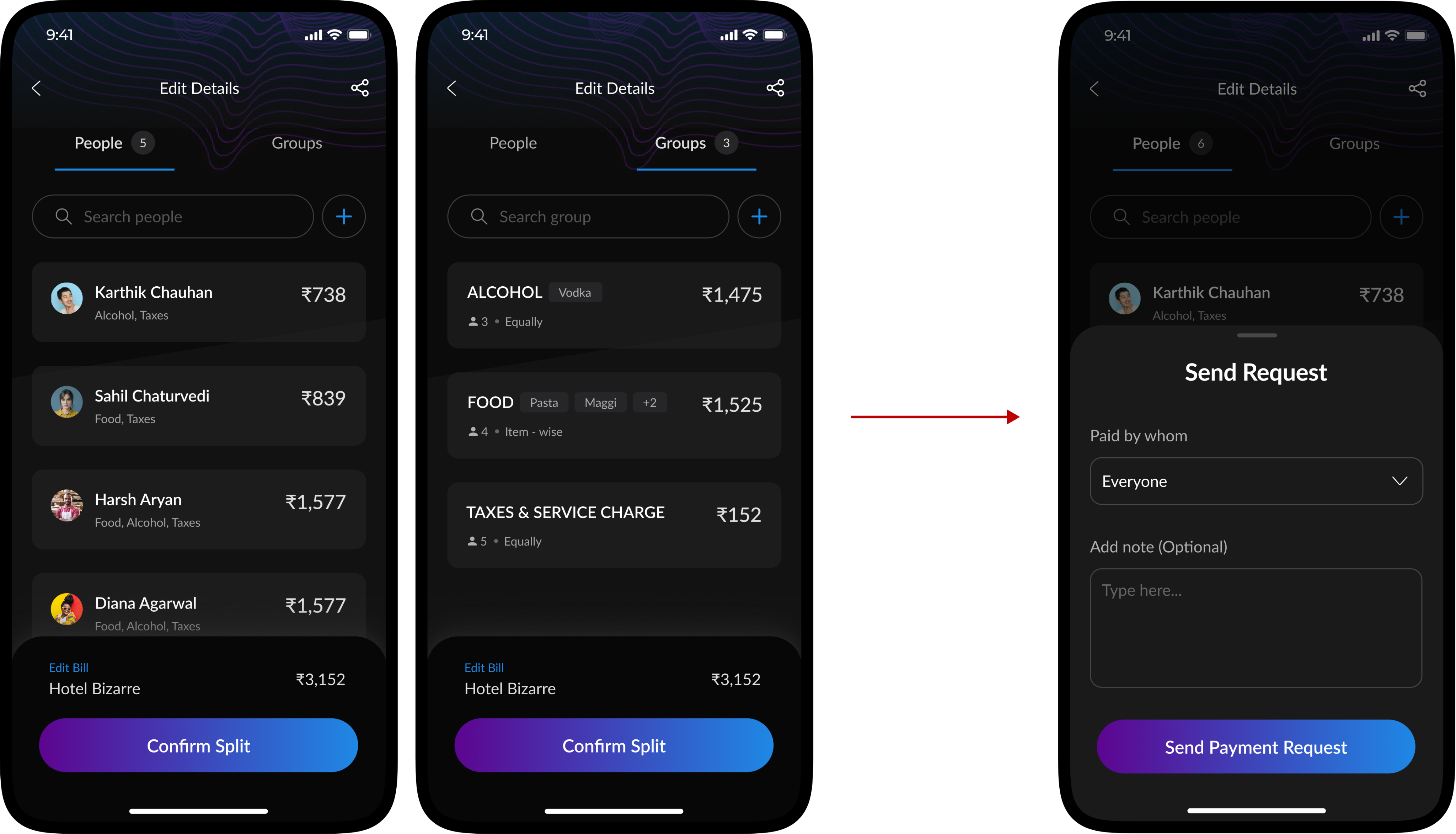
Placement refinement: Bill summary moved to bottom for checkout familiarity and persistent visibility during review
EDGE-CASES
Designing for the Real World
Standard "happy-path" designs fail in loud, dark restaurants or with blurry receipts. I solved for these critical friction points to ensure 120M+ users can actually finish the transaction when things go wrong.
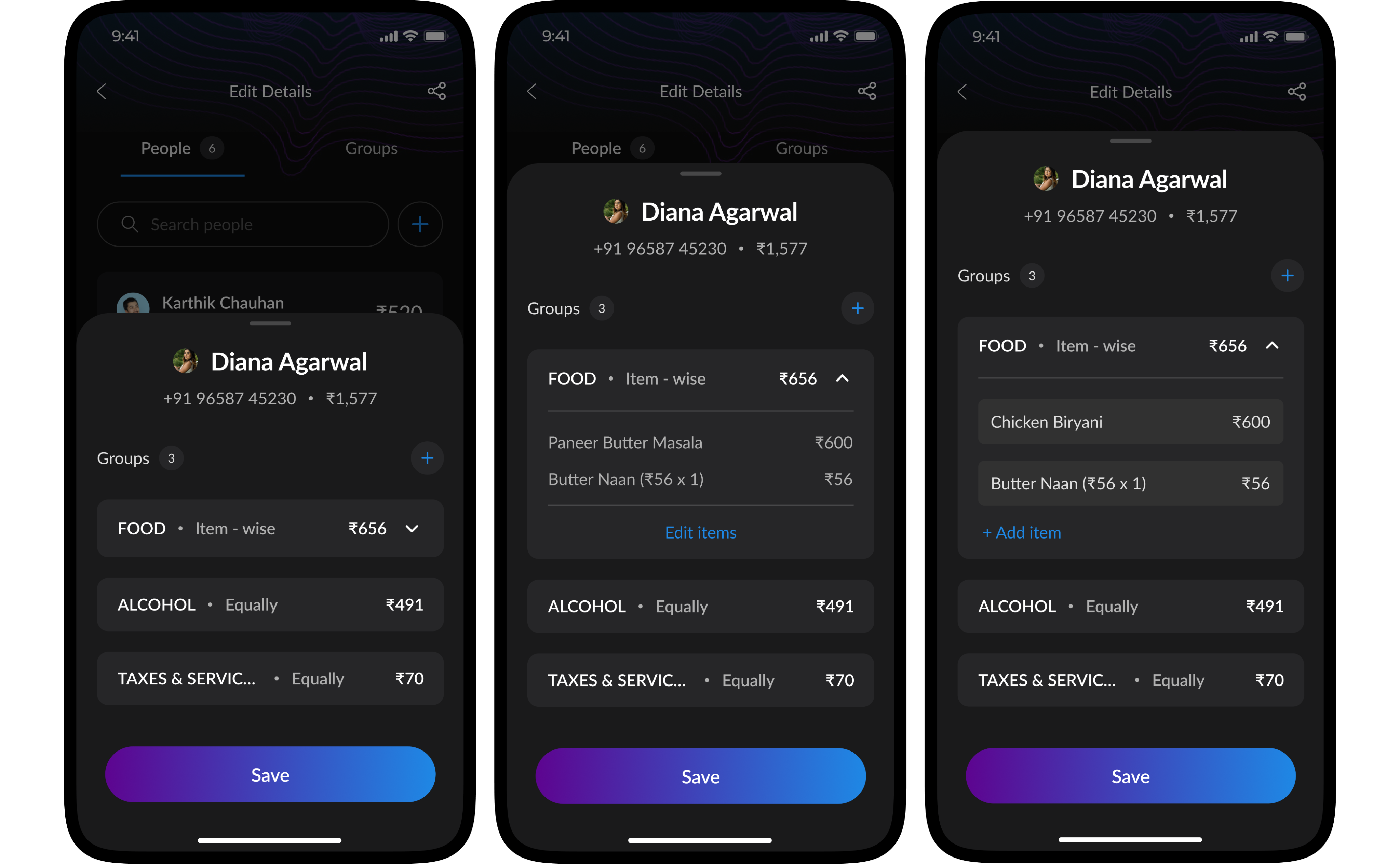
➡️ How do we prove the math is fair?
People won't pay if they don't see exactly what they’re paying for.
Goal
Total Transparency
Challenge
Showing every item adds "visual noise" and takes up too much screen space.
Solution
Smart Accordions: Bills stay collapsed by default. One tap shows the full itemized breakdown for quick proof.
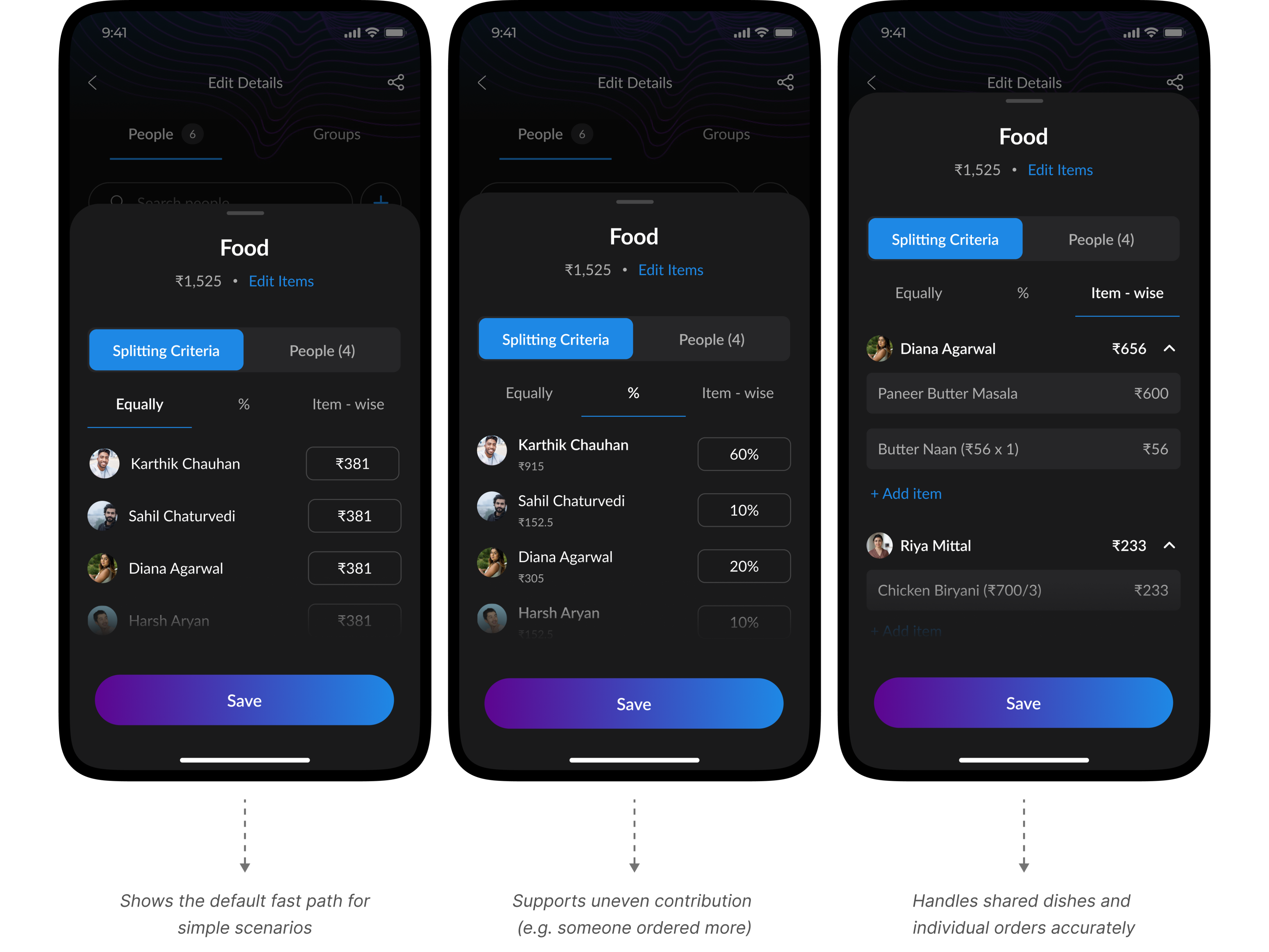
➡️ What if everyone isn't sharing equally?
A single split method often feels unfair, so I designed flexible rules that match how people actually eat.
Goal
Complete Fairness
Challenge
High accuracy usually requires high manual effort. Forcing users to map every item manually for item-based splitting creates friction that leads to app abandonment.
Solution
Automated One-Tap Logic: Since guests already selected their items during the initial QR scan, the math is pre-calculated. The host can switch between Equal, %, or Item-wise splits with one tap, instantly updating the totals without manual re-entry.
➡️ What if the bill needs changes after scanning?
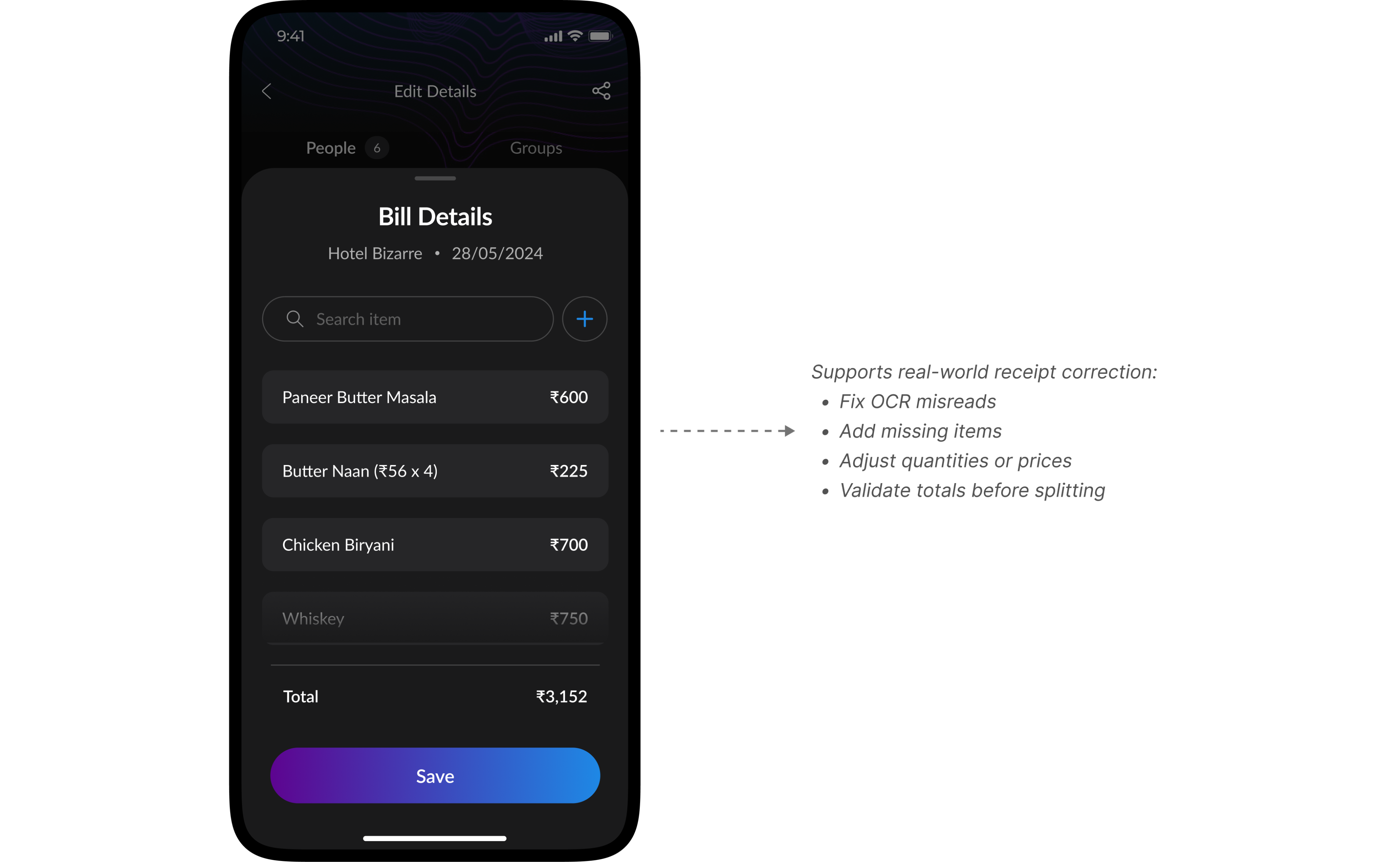
The bill remains editable after scanning, so users can search, add, remove, or adjust items with totals recalculated instantly
Goal
Ensure 100% bill accuracy
Challenge
Most OCR systems are "locked", if a price is misread, the user has to restart the entire scan, causing high frustration.
Solution
Live Bill Correction: The bill remains fully interactive after scanning; users can fix misreads, add items, or adjust prices with instant total recalculations.
Usability testing insights for the split flow
Study Setup
Method: Remote unmoderated usability test (Maze)Participants: n=16Prototype fidelity: Clickable linear prototypeEnvironment: Remote, individual settings (no social distraction simulated)
Task: Scan a bill → review split → send payment request
Goal: Validate whether users can understand and complete the full split flow independently
Key Results
7 success, 9 failures
Failure reasons:
- Early splash abandonment
- Clicking non-interactive elements
43.8%
Task completion
56.3%
Drop-off
55.8%
Misclick rate
65.4 sec
Average completion time
Entry friction caused early abandonment
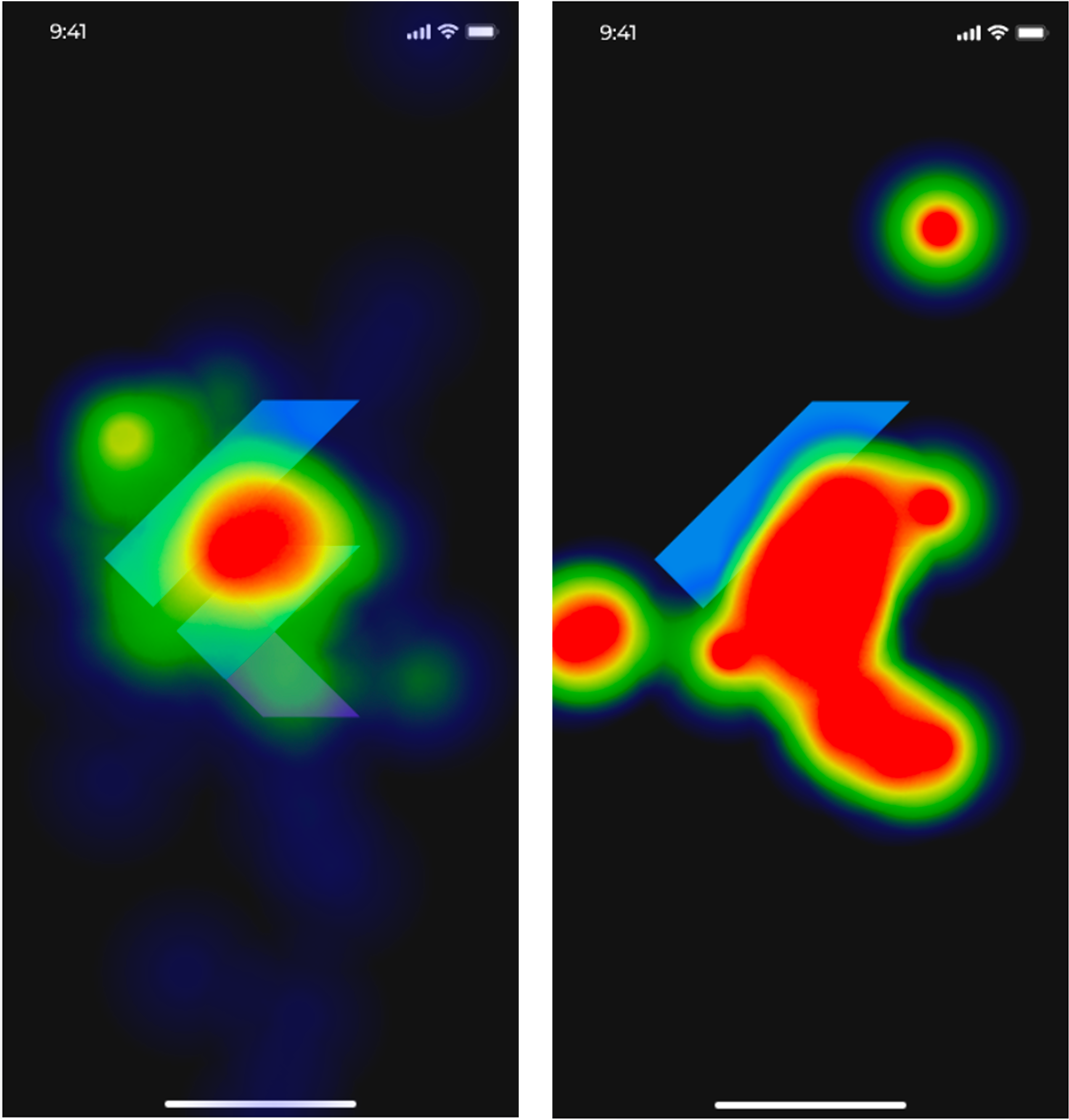
Maze task data showed that ~50% of participants abandoned the flow on the splash screen before reaching the split interface
User impact
Unclear loading state created uncertainty and perceived app unresponsiveness, causing frustration and early exit before the task began
Business impact
Splash abandonment → users never reach core value → fewer successful splits → lower engagement → weaker retention → revenue risk
Design requirement
Entry must be short, clearly indicate loading progress, and transition predictably to the split screen
Users independently verified splits before confirmation
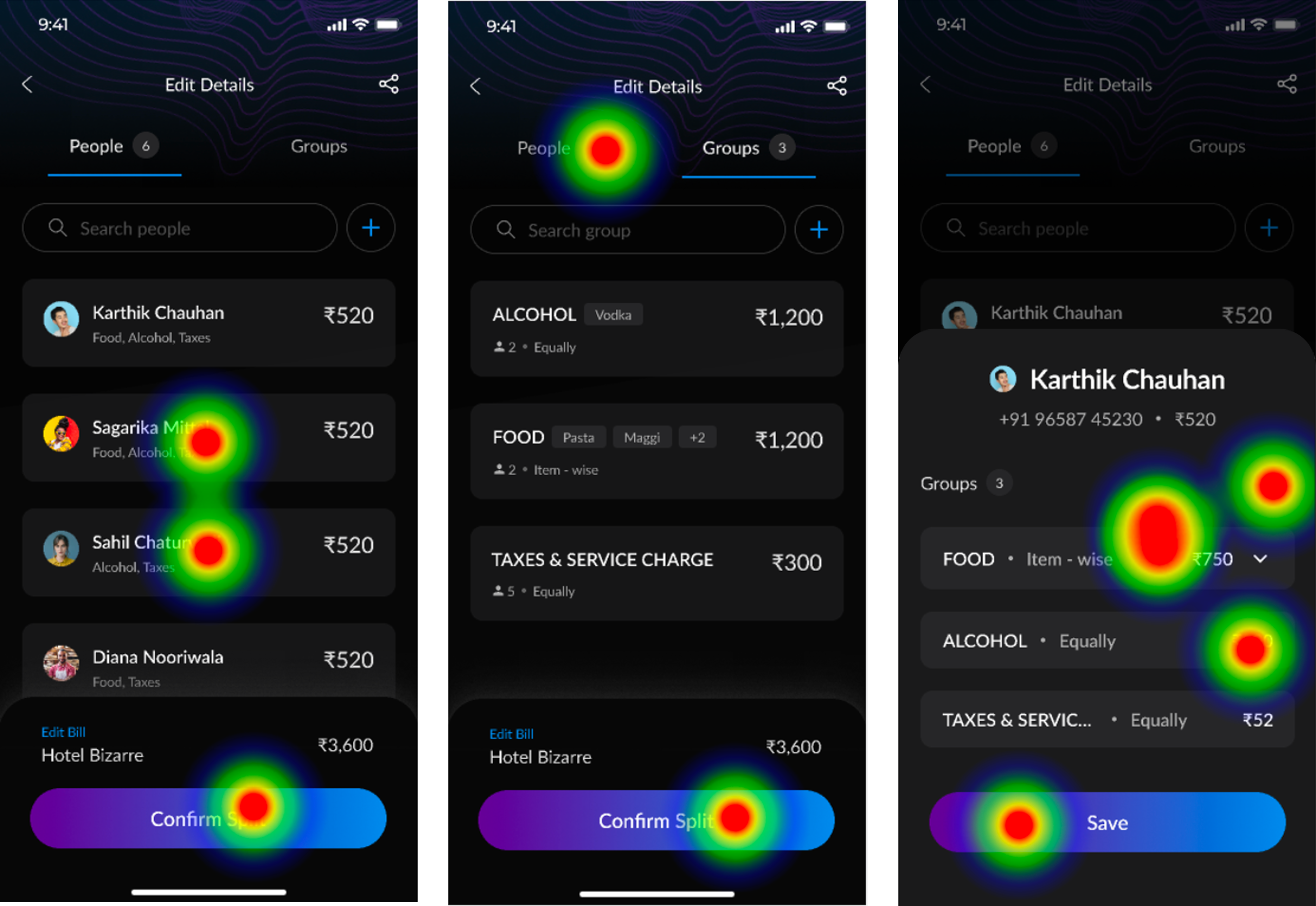
Heatmaps from successful participants show concentrated inspection of assignments prior to confirmation
Analysis
Users formed the correct mental model of item allocation and independently verified split accuracy before committing
User impact
The review layout supported confident verification and completion without external guidance
Behavioral findings
Users abandon when system status is unclear
→ Reduces task start and engagement
01
Users verify assignments before committing
→ Supports confident completion
02
Expected impact
User
- Faster, lower-effort settlement without reconstructing shares
- High confidence before payment through verify-then-confirm review
Business
- Faster split completion, especially in unequal-consumption cases
- Reduced allocation errors reaching confirmation
- More repeat group settlement (repeat rate)
- Higher adoption of item-level splitting over equal defaults
Learnings and reflection
Clear system status is critical before financial actions
This study reinforced how quickly users disengage when responsiveness is uncertain at entry
Users validate automated outcomes through visible structure
I learned that assignment visibility rather than totals enables users to confirm split accuracy
Verification behavior can indicate understanding, not friction
This project taught me that careful checking in financial tasks often reflects user validation rather than confusion
Explore my other case studies below to see how I design real-world product experiences end to end.

@Let’s build something together

Designing for 120M+ Users: Solving the Social Friction of Fair Bill-Splitting in India
Using OCR and QR flows so users only pay for what they consumed and settle debts instantly.
Type: B2C
Industry: Fintech
Scope: Research → Full-Cycle UX/UI → Usability Testing (𝑛=16) + Heatmap Analysis
My Role: End-to-end ownership, user research (surveys & interviews), UX strategy, final UI design, and usability testing
TL;DR
Problem
Most bill-splitting apps force a trade-off: users must choose between an unfair 'even split' or a labor-intensive manual entry for item-based split
Solution
By combining OCR bill scanning with a QR-triggered web flow, participants can instantly join and assign their own consumption
Intended impact
- Faster Time-to-Payment: Instead of waiting until everyone gets home to 'figure out the bill' (which leads to forgotten debts), users assign and verify their shares in the moment
- Lower Interaction Cost: OCR turns a 5-minute manual typing chore into a 5-second "scan bill & verify" step, drastically reducing the cognitive load for the host
- Increased Long-Term Retention: Users return to a product that solves social friction
The Approach
01

Identifying the Friction
Conducted 6 user interviews + survey responses to understand how groups currently settle bills and where friction emerges
02
Simplifying the Logic
Explored multiple splitting models to evaluate cognitive load and decision clarity
03
Perfecting the Payment Flow
Conducted usability testing on key flows (scan → assign → validate → trigger payment)
SCOPE
Market Size in India (2026)
With over 21 billion monthly UPI transactions, urban Indians are ready for a digital-first solution that eliminates the 'social tax' of manual bill splitting.
*Sources: NPCI Digital Payment Dashboard (2026), UN Population Fund India, Redseer Gen Z Spending Report, and Deloitte TMT Predictions 2026.
Target Audience
Focusing on 120M+ urban social spenders who prioritize total financial precision and seamless, app-free digital payments
RESEARCH & DISCOVERY
Studying the "Social Split" Conflict
A survey of 12 frequent splitters and 6 deep-dive interviews revealed that while users value fairness, the "math friction" at the table forces them into poor financial habits.
“Equal split” remains the behavioral default
58.3%
Usually split bills equally despite uneven consumption
66.7%
Feel uncomfortable paying for items they didn’t consume
Users still do the “manual math”
58.3%
Rely on manual calculation instead of apps
41.7%
Reported confusion or mistakes during settlement
In users’ words
“The idea that everyone is comfortable with the way you are sharing the bill makes the process easier, because even if one person doesn't like the way, there is a problem.”
- Participant, Associate Lawyer
“If I go out often, then I definitely care about alcoholic and non-alcoholic split… I may have to pay for what I had.”
- Participant, Student
COMPETITIVE ANALYSIS
Why existing splitting apps create settlement friction
I evaluated the three most common split apps (Splitwise, SettleUp, SplitKaro) and found that they all suffer from a "Manual Reconstruction" problem. Instead of simplifying the process, they add extra layers of digital chores
Some examples from the market
Even major apps like Splitwise lock item-based splitting behind a $5/month paywall, leaving free users stuck with manual math
PROBLEM
Accurate Splitting is a Manual Chore
Most bill-splitting apps force a trade-off: users must choose between an unfair 'even split' or a labor-intensive manual entry for item-based split (if available)
Impact
⚠️ High Interaction Cost
Typing 15+ items into an app takes 5+ minutes, leading to extensive manual labour
⚠️ High Task Abandonment
Forcing every guest to download an app and create an account kills the momentum of instant payment
⚠️ Increased Time-To-Payment
By stopping at 'Save,' current apps create a 'Settlement Gap' that kills payment conversion and leaves debts unpaid for days
THE NEW USER FLOW
The 'Scan-to-Settle' Direct Flow
IDEATIONS
Finding the Right Flow
➡️ How do we handle the chaos of a real restaurant (Low light, bad camera, loud environment)?
Users often split bills in low-attention social contexts, where scanning may be slow or unclear
➡️ What happens when the AI gets it wrong?
Instead of fully automatic grouping, I chose AI-assisted editing so users can quickly fix errors without feeling stuck.
➡️ How do we build trust before the final request?
nstead of cluttering the final step with editing tools, I prioritized a structured summary so users can verify totals at a glance before sending requests.
FINAL DESIGN
Bridging the Settlement Gap
Step 1: Automated OCR Data Extraction
Eliminates the "Manual Entry Tax." Users get the fairness of item-based splitting with the speed of an equal split.
Reduces interaction cost of manual data entry by 90%
Step 2: Frictionless Web-Join Flow
Eliminates the "App-Store barrier" by allowing guests to join instantly via a browser rather than the mandatory download and sign-up phase.
- Low Task Abandonment: Eliminates drop-off due to mandatory app downloads or forgotten passwords
- Higher Task Success Rate: The process of allocating consumption for each user is significantly faster than market standards
Step 3: Live-Sync Settlement
Total transparency. When a user sees their exact consumption confirmed by the host, the "Time-to-Payment" accelerates.
Accelerated Time-To-Payment: Prevents the awkward "Wait, why is my total so high?" conversation, ensuring a successful payment rate
Placement refinement: Bill summary moved to bottom for checkout familiarity and persistent visibility during review
EDGE-CASES
Designing for the Real World
Standard "happy-path" designs fail in loud, dark restaurants or with blurry receipts. I solved for these critical friction points to ensure 120M+ users can actually finish the transaction when things go wrong.
➡️ How do we prove the math is fair?
People won't pay if they don't see exactly what they’re paying for.
Goal
Total Transparency
Challenge
Showing every item adds "visual noise" and takes up too much screen space.
Solution
Smart Accordions: Bills stay collapsed by default. One tap shows the full itemized breakdown for quick proof.
➡️ What if everyone isn't sharing equally?
A single split method often feels unfair, so I designed flexible rules that match how people actually eat.
Goal
Complete Fairness
Challenge
High accuracy usually requires high manual effort. Forcing users to map every item manually for item-based splitting creates friction that leads to app abandonment.
Solution
Automated One-Tap Logic: Since guests already selected their items during the initial QR scan, the math is pre-calculated. The host can switch between Equal, %, or Item-wise splits with one tap, instantly updating the totals without manual re-entry.
➡️ What if the bill needs changes after scanning?
The bill remains editable after scanning, so users can search, add, remove, or adjust items with totals recalculated instantly
Goal
Ensure 100% bill accuracy
Challenge
Most OCR systems are "locked", if a price is misread, the user has to restart the entire scan, causing high frustration.
Solution
Live Bill Correction: The bill remains fully interactive after scanning; users can fix misreads, add items, or adjust prices with instant total recalculations.
Usability testing insights for the split flow
Study Setup
Method: Remote unmoderated usability test (Maze)Participants: n=16Prototype fidelity: Clickable linear prototypeEnvironment: Remote, individual settings (no social distraction simulated)
Task: Scan a bill → review split → send payment request
Goal: Validate whether users can understand and complete the full split flow independently
Key Results
7 success, 9 failures
Failure reasons:
- Early splash abandonment
- Clicking non-interactive elements
43.8%
Task completion
56.3%
Drop-off
55.8%
Misclick rate
65.4 sec
Average completion time
Entry friction caused early abandonment
Maze task data showed that ~50% of participants abandoned the flow on the splash screen before reaching the split interface
User impact
Unclear loading state created uncertainty and perceived app unresponsiveness, causing frustration and early exit before the task began
Business impact
Splash abandonment → users never reach core value → fewer successful splits → lower engagement → weaker retention → revenue risk
Design requirement
Entry must be short, clearly indicate loading progress, and transition predictably to the split screen
Users independently verified splits before confirmation
Heatmaps from successful participants show concentrated inspection of assignments prior to confirmation
Analysis
Users formed the correct mental model of item allocation and independently verified split accuracy before committing
User impact
The review layout supported confident verification and completion without external guidance
Behavioral findings
Users abandon when system status is unclear
→ Reduces task start and engagement
01
Users verify assignments before committing
→ Supports confident completion
02
Expected impact
User
- Faster, lower-effort settlement without reconstructing shares
- High confidence before payment through verify-then-confirm review
Business
- Faster split completion, especially in unequal-consumption cases
- Reduced allocation errors reaching confirmation
- More repeat group settlement (repeat rate)
- Higher adoption of item-level splitting over equal defaults
Learnings and reflection
Clear system status is critical before financial actions
This study reinforced how quickly users disengage when responsiveness is uncertain at entry
Users validate automated outcomes through visible structure
I learned that assignment visibility rather than totals enables users to confirm split accuracy
Verification behavior can indicate understanding, not friction
This project taught me that careful checking in financial tasks often reflects user validation rather than confusion
Explore my other case studies below to see how I design real-world product experiences end to end.

@Let’s build something together
Contact me
LinkedInDesigning for 120M+ Users: Solving the Social Friction of Fair Bill-Splitting in India
Using OCR and QR flows so users only pay for what they consumed and settle debts instantly.
Type: B2C
Industry: Fintech
Scope: Research → Full-Cycle UX/UI → Usability Testing (𝑛=16) + Heatmap Analysis
My Role: End-to-end ownership, user research (surveys & interviews), UX strategy, final UI design, and usability testing
TL;DR
Problem
Most bill-splitting apps force a trade-off: users must choose between an unfair 'even split' or a labor-intensive manual entry for item-based split
Solution
By combining OCR bill scanning with a QR-triggered web flow, participants can instantly join and assign their own consumption
Intended impact
- Faster Time-to-Payment: Instead of waiting until everyone gets home to 'figure out the bill' (which leads to forgotten debts), users assign and verify their shares in the moment
- Lower Interaction Cost: OCR turns a 5-minute manual typing chore into a 5-second "scan bill & verify" step, drastically reducing the cognitive load for the host
- Increased Long-Term Retention: Users return to a product that solves social friction
The Approach
01
Identifying the Friction
Conducted 6 user interviews + survey responses to understand how groups currently settle bills and where friction emerges
02
Simplifying the Logic
Explored multiple splitting models to evaluate cognitive load and decision clarity
03
Perfecting the Payment Flow
Conducted usability testing on key flows (scan → assign → validate → trigger payment)
SCOPE
Market Size in India (2026)
With over 21 billion monthly UPI transactions, urban Indians are ready for a digital-first solution that eliminates the 'social tax' of manual bill splitting.
*Sources: NPCI Digital Payment Dashboard (2026), UN Population Fund India, Redseer Gen Z Spending Report, and Deloitte TMT Predictions 2026.
Target Audience
Focusing on 120M+ urban social spenders who prioritize total financial precision and seamless, app-free digital payments
RESEARCH & DISCOVERY
Studying the "Social Split" Conflict
A survey of 12 frequent splitters and 6 deep-dive interviews revealed that while users value fairness, the "math friction" at the table forces them into poor financial habits.
“Equal split” remains the behavioral default
58.3%
Usually split bills equally despite uneven consumption
66.7%
Feel uncomfortable paying for items they didn’t consume
Users still do the “manual math”
58.3%
Rely on manual calculation instead of apps
41.7%
Reported confusion or mistakes during settlement
In users’ words
“The idea that everyone is comfortable with the way you are sharing the bill makes the process easier, because even if one person doesn't like the way, there is a problem.”
- Participant, Associate Lawyer
“If I go out often, then I definitely care about alcoholic and non-alcoholic split… I may have to pay for what I had.”
- Participant, Student
COMPETITIVE ANALYSIS
Why existing splitting apps create settlement friction
I evaluated the three most common split apps (Splitwise, SettleUp, SplitKaro) and found that they all suffer from a "Manual Reconstruction" problem. Instead of simplifying the process, they add extra layers of digital chores
Some examples from the market
Even major apps like Splitwise lock item-based splitting behind a $5/month paywall, leaving free users stuck with manual math
PROBLEM
Accurate Splitting is a Manual Chore
Most bill-splitting apps force a trade-off: users must choose between an unfair 'even split' or a labor-intensive manual entry for item-based split (if available)
Impact
⚠️ High Interaction Cost
Typing 15+ items into an app takes 5+ minutes, leading to extensive manual labour
⚠️ High Task Abandonment
Forcing every guest to download an app and create an account kills the momentum of instant payment
⚠️ Increased Time-To-Payment
By stopping at 'Save,' current apps create a 'Settlement Gap' that kills payment conversion and leaves debts unpaid for days
THE NEW USER FLOW
The 'Scan-to-Settle' Direct Flow
IDEATIONS
Finding the Right Flow
➡️ How do we handle the chaos of a real restaurant (Low light, bad camera, loud environment)?
Users often split bills in low-attention social contexts, where scanning may be slow or unclear
➡️ What happens when the AI gets it wrong?
Instead of fully automatic grouping, I chose AI-assisted editing so users can quickly fix errors without feeling stuck.
➡️ How do we build trust before the final request?
nstead of cluttering the final step with editing tools, I prioritized a structured summary so users can verify totals at a glance before sending requests.
FINAL DESIGN
Bridging the Settlement Gap
Step 1: Automated OCR Data Extraction
Eliminates the "Manual Entry Tax." Users get the fairness of item-based splitting with the speed of an equal split.
Reduces interaction cost of manual data entry by 90%
Step 2: Frictionless Web-Join Flow
Eliminates the "App-Store barrier" by allowing guests to join instantly via a browser rather than the mandatory download and sign-up phase.
- Low Task Abandonment: Eliminates drop-off due to mandatory app downloads or forgotten passwords
- Higher Task Success Rate: The process of allocating consumption for each user is significantly faster than market standards
Step 3: Live-Sync Settlement
Total transparency. When a user sees their exact consumption confirmed by the host, the "Time-to-Payment" accelerates.
Accelerated Time-To-Payment: Prevents the awkward "Wait, why is my total so high?" conversation, ensuring a successful payment rate
Placement refinement: Bill summary moved to bottom for checkout familiarity and persistent visibility during review
EDGE-CASES
Designing for the Real World
Standard "happy-path" designs fail in loud, dark restaurants or with blurry receipts. I solved for these critical friction points to ensure 120M+ users can actually finish the transaction when things go wrong.
➡️ How do we prove the math is fair?
People won't pay if they don't see exactly what they’re paying for.
Goal
Total Transparency
Challenge
Showing every item adds "visual noise" and takes up too much screen space.
Solution
Smart Accordions: Bills stay collapsed by default. One tap shows the full itemized breakdown for quick proof.
➡️ What if everyone isn't sharing equally?
A single split method often feels unfair, so I designed flexible rules that match how people actually eat.
Goal
Complete Fairness
Challenge
High accuracy usually requires high manual effort. Forcing users to map every item manually for item-based splitting creates friction that leads to app abandonment.
Solution
Automated One-Tap Logic: Since guests already selected their items during the initial QR scan, the math is pre-calculated. The host can switch between Equal, %, or Item-wise splits with one tap, instantly updating the totals without manual re-entry.
➡️ What if the bill needs changes after scanning?
The bill remains editable after scanning, so users can search, add, remove, or adjust items with totals recalculated instantly
Goal
Ensure 100% bill accuracy
Challenge
Most OCR systems are "locked", if a price is misread, the user has to restart the entire scan, causing high frustration.
Solution
Live Bill Correction: The bill remains fully interactive after scanning; users can fix misreads, add items, or adjust prices with instant total recalculations.
Usability testing insights for the split flow
Study Setup
Method: Remote unmoderated usability test (Maze)Participants: n=16Prototype fidelity: Clickable linear prototypeEnvironment: Remote, individual settings (no social distraction simulated)
Task: Scan a bill → review split → send payment request
Goal: Validate whether users can understand and complete the full split flow independently
Key Results
7 success, 9 failures
Failure reasons:
- Early splash abandonment
- Clicking non-interactive elements
43.8%
Task completion
56.3%
Drop-off
55.8%
Misclick rate
65.4 sec
Average completion time
Entry friction caused early abandonment
Maze task data showed that ~50% of participants abandoned the flow on the splash screen before reaching the split interface
User impact
Unclear loading state created uncertainty and perceived app unresponsiveness, causing frustration and early exit before the task began
Business impact
Splash abandonment → users never reach core value → fewer successful splits → lower engagement → weaker retention → revenue risk
Design requirement
Entry must be short, clearly indicate loading progress, and transition predictably to the split screen
Users independently verified splits before confirmation
Heatmaps from successful participants show concentrated inspection of assignments prior to confirmation
Analysis
Users formed the correct mental model of item allocation and independently verified split accuracy before committing
User impact
The review layout supported confident verification and completion without external guidance
Behavioral findings
Users abandon when system status is unclear
→ Reduces task start and engagement
01
Users verify assignments before committing
→ Supports confident completion
02
Expected impact
User
- Faster, lower-effort settlement without reconstructing shares
- High confidence before payment through verify-then-confirm review
Business
- Faster split completion, especially in unequal-consumption cases
- Reduced allocation errors reaching confirmation
- More repeat group settlement (repeat rate)
- Higher adoption of item-level splitting over equal defaults
Learnings and reflection
Clear system status is critical before financial actions
This study reinforced how quickly users disengage when responsiveness is uncertain at entry
Users validate automated outcomes through visible structure
I learned that assignment visibility rather than totals enables users to confirm split accuracy
Verification behavior can indicate understanding, not friction
This project taught me that careful checking in financial tasks often reflects user validation rather than confusion
Explore my other case studies below to see how I design real-world product experiences end to end.

@Let’s build something together
Contact me
LinkedInDesigning for 120M+ Users: Solving the Social Friction of Fair Bill-Splitting in India
Using OCR and QR flows so users only pay for what they consumed and settle debts instantly.
Type: B2C
Industry: Fintech
Scope: Research → Full-Cycle UX/UI → Usability Testing (𝑛=16) + Heatmap Analysis
My Role: End-to-end ownership, user research (surveys & interviews), UX strategy, final UI design, and usability testing
TL;DR
Problem
Most bill-splitting apps force a trade-off: users must choose between an unfair 'even split' or a labor-intensive manual entry for item-based split
Solution
By combining OCR bill scanning with a QR-triggered web flow, participants can instantly join and assign their own consumption
Intended impact
- Faster Time-to-Payment: Instead of waiting until everyone gets home to 'figure out the bill' (which leads to forgotten debts), users assign and verify their shares in the moment
- Lower Interaction Cost: OCR turns a 5-minute manual typing chore into a 5-second "scan bill & verify" step, drastically reducing the cognitive load for the host
- Increased Long-Term Retention: Users return to a product that solves social friction
The Approach
01
Identifying the Friction
Conducted 6 user interviews + survey responses to understand how groups currently settle bills and where friction emerges
02
Simplifying the Logic
Explored multiple splitting models to evaluate cognitive load and decision clarity
03
Perfecting the Payment Flow
Conducted usability testing on key flows (scan → assign → validate → trigger payment)
SCOPE
Market Size in India (2026)
With over 21 billion monthly UPI transactions, urban Indians are ready for a digital-first solution that eliminates the 'social tax' of manual bill splitting.
*Sources: NPCI Digital Payment Dashboard (2026), UN Population Fund India, Redseer Gen Z Spending Report, and Deloitte TMT Predictions 2026.
Target Audience
Focusing on 120M+ urban social spenders who prioritize total financial precision and seamless, app-free digital payments
RESEARCH & DISCOVERY
Studying the "Social Split" Conflict
A survey of 12 frequent splitters and 6 deep-dive interviews revealed that while users value fairness, the "math friction" at the table forces them into poor financial habits.
“Equal split” remains the behavioral default
58.3%
Usually split bills equally despite uneven consumption
66.7%
Feel uncomfortable paying for items they didn’t consume
Users still do the “manual math”
58.3%
Rely on manual calculation instead of apps
41.7%
Reported confusion or mistakes during settlement
In users’ words
“The idea that everyone is comfortable with the way you are sharing the bill makes the process easier, because even if one person doesn't like the way, there is a problem.”
- Participant, Associate Lawyer
“If I go out often, then I definitely care about alcoholic and non-alcoholic split… I may have to pay for what I had.”
- Participant, Student
COMPETITIVE ANALYSIS
Why existing splitting apps create settlement friction
I evaluated the three most common split apps (Splitwise, SettleUp, SplitKaro) and found that they all suffer from a "Manual Reconstruction" problem. Instead of simplifying the process, they add extra layers of digital chores
Some examples from the market
Even major apps like Splitwise lock item-based splitting behind a $5/month paywall, leaving free users stuck with manual math
PROBLEM
Accurate Splitting is a Manual Chore
Most bill-splitting apps force a trade-off: users must choose between an unfair 'even split' or a labor-intensive manual entry for item-based split (if available)
Impact
⚠️ High Interaction Cost
Typing 15+ items into an app takes 5+ minutes, leading to extensive manual labour
⚠️ High Task Abandonment
Forcing every guest to download an app and create an account kills the momentum of instant payment
⚠️ Increased Time-To-Payment
By stopping at 'Save,' current apps create a 'Settlement Gap' that kills payment conversion and leaves debts unpaid for days
THE NEW USER FLOW
The 'Scan-to-Settle' Direct Flow
IDEATIONS
Finding the Right Flow
➡️ How do we handle the chaos of a real restaurant (Low light, bad camera, loud environment)?
Users often split bills in low-attention social contexts, where scanning may be slow or unclear
➡️ What happens when the AI gets it wrong?
Instead of fully automatic grouping, I chose AI-assisted editing so users can quickly fix errors without feeling stuck.
➡️ How do we build trust before the final request?
Instead of cluttering the final step with editing tools, I prioritized a structured summary so users can verify totals at a glance before sending requests.
FINAL DESIGN
Bridging the Settlement Gap
Step 1: Automated OCR Data Extraction
Eliminates the "Manual Entry Tax." Users get the fairness of item-based splitting with the speed of an equal split.
Reduces interaction cost of manual data entry by 90%
Step 2: Frictionless Web-Join Flow
Eliminates the "App-Store barrier" by allowing guests to join instantly via a browser rather than the mandatory download and sign-up phase.
- Low Task Abandonment: Eliminates drop-off due to mandatory app downloads or forgotten passwords
- Higher Task Success Rate: The process of allocating consumption for each user is significantly faster than market standards
Step 3: Live-Sync Settlement
Total transparency. When a user sees their exact consumption confirmed by the host, the "Time-to-Payment" accelerates.
Accelerated Time-To-Payment: Prevents the awkward "Wait, why is my total so high?" conversation, ensuring a successful payment rate
Placement refinement: Bill summary moved to bottom for checkout familiarity and persistent visibility during review
EDGE-CASES
Designing for the Real World
Standard "happy-path" designs fail in loud, dark restaurants or with blurry receipts. I solved for these critical friction points to ensure 120M+ users can actually finish the transaction when things go wrong.
➡️ How do we prove the math is fair?
People won't pay if they don't see exactly what they’re paying for.
Goal
Total Transparency
Challenge
Showing every item adds "visual noise" and takes up too much screen space.
Solution
Smart Accordions: Bills stay collapsed by default. One tap shows the full itemized breakdown for quick proof.
➡️ What if everyone isn't sharing equally?
A single split method often feels unfair, so I designed flexible rules that match how people actually eat.
Goal
Complete Fairness
Challenge
High accuracy usually requires high manual effort. Forcing users to map every item manually for item-based splitting creates friction that leads to app abandonment.
Solution
Automated One-Tap Logic: Since guests already selected their items during the initial QR scan, the math is pre-calculated. The host can switch between Equal, %, or Item-wise splits with one tap, instantly updating the totals without manual re-entry.
➡️ What if the bill needs changes after scanning?
The bill remains editable after scanning, so users can search, add, remove, or adjust items with totals recalculated instantly
Goal
Ensure 100% bill accuracy
Challenge
Most OCR systems are "locked", if a price is misread, the user has to restart the entire scan, causing high frustration.
Solution
Live Bill Correction: The bill remains fully interactive after scanning; users can fix misreads, add items, or adjust prices with instant total recalculations.
Usability testing insights for the split flow
Study Setup
Method: Remote unmoderated usability test (Maze)Participants: n=16Prototype fidelity: Clickable linear prototypeEnvironment: Remote, individual settings (no social distraction simulated)
Task: Scan a bill → review split → send payment request
Goal: Validate whether users can understand and complete the full split flow independently
Key Results
7 success, 9 failures
Failure reasons:
- Early splash abandonment
- Clicking non-interactive elements
43.8%
Task completion
56.3%
Drop-off
55.8%
Misclick rate
65.4 sec
Average completion time
Entry friction caused early abandonment
Maze task data showed that ~50% of participants abandoned the flow on the splash screen before reaching the split interface
User impact
Unclear loading state created uncertainty and perceived app unresponsiveness, causing frustration and early exit before the task began
Business impact
Splash abandonment → users never reach core value → fewer successful splits → lower engagement → weaker retention → revenue risk
Design requirement
Entry must be short, clearly indicate loading progress, and transition predictably to the split screen
Users independently verified splits before confirmation
Heatmaps from successful participants show concentrated inspection of assignments prior to confirmation
Analysis
Users formed the correct mental model of item allocation and independently verified split accuracy before committing
User impact
The review layout supported confident verification and completion without external guidance
Behavioral findings
Users abandon when system status is unclear
→ Reduces task start and engagement
01
Users verify assignments before committing
→ Supports confident completion
02
Expected impact
User
- Faster, lower-effort settlement without reconstructing shares
- High confidence before payment through verify-then-confirm review
Business
- Faster split completion, especially in unequal-consumption cases
- Reduced allocation errors reaching confirmation
- More repeat group settlement (repeat rate)
- Higher adoption of item-level splitting over equal defaults
Learnings and reflection
Clear system status is critical before financial actions
This study reinforced how quickly users disengage when responsiveness is uncertain at entry
Users validate automated outcomes through visible structure
I learned that assignment visibility rather than totals enables users to confirm split accuracy
Verification behavior can indicate understanding, not friction
This project taught me that careful checking in financial tasks often reflects user validation rather than confusion
Explore my other case studies below to see how I design real-world product experiences end to end.

@Let’s build something together
Contact me
LinkedInDesigning for 120M+ Users: Solving the Social Friction of Fair Bill-Splitting in India
Using OCR and QR flows so users only pay for what they consumed and settle debts instantly.
Type: B2C
Industry: Fintech
Scope: Research → Full-Cycle UX/UI → Usability Testing (𝑛=16) + Heatmap Analysis
My Role: End-to-end ownership, user research (surveys & interviews), UX strategy, final UI design, and usability testing
TL;DR
Problem
Most bill-splitting apps force a trade-off: users must choose between an unfair 'even split' or a labor-intensive manual entry for item-based split
Solution
By combining OCR bill scanning with a QR-triggered web flow, participants can instantly join and assign their own consumption
Intended impact
- Faster Time-to-Payment: Instead of waiting until everyone gets home to 'figure out the bill' (which leads to forgotten debts), users assign and verify their shares in the moment
- Lower Interaction Cost: OCR turns a 5-minute manual typing chore into a 5-second "scan bill & verify" step, drastically reducing the cognitive load for the host
- Increased Long-Term Retention: Users return to a product that solves social friction
The Approach
01
Identifying the Friction
Conducted 6 user interviews + survey responses to understand how groups currently settle bills and where friction emerges
02
Simplifying the Logic
Explored multiple splitting models to evaluate cognitive load and decision clarity
03
Perfecting the Payment Flow
Conducted usability testing on key flows (scan → assign → validate → trigger payment)
SCOPE
Market Size in India (2026)
With over 21 billion monthly UPI transactions, urban Indians are ready for a digital-first solution that eliminates the 'social tax' of manual bill splitting.
*Sources: NPCI Digital Payment Dashboard (2026), UN Population Fund India, Redseer Gen Z Spending Report, and Deloitte TMT Predictions 2026.
Target Audience
Focusing on 120M+ urban social spenders who prioritize total financial precision and seamless, app-free digital payments
RESEARCH & DISCOVERY
Studying the "Social Split" Conflict
A survey of 12 frequent splitters and 6 deep-dive interviews revealed that while users value fairness, the "math friction" at the table forces them into poor financial habits.
“Equal split” remains the behavioral default
58.3%
Usually split bills equally despite uneven consumption
66.7%
Feel uncomfortable paying for items they didn’t consume
Users still do the “manual math”
58.3%
Rely on manual calculation instead of apps
41.7%
Reported confusion or mistakes during settlement
In users’ words
“The idea that everyone is comfortable with the way you are sharing the bill makes the process easier, because even if one person doesn't like the way, there is a problem.”
- Participant, Associate Lawyer
“If I go out often, then I definitely care about alcoholic and non-alcoholic split… I may have to pay for what I had.”
- Participant, Student
COMPETITIVE ANALYSIS
Why existing splitting apps create settlement friction
I evaluated the three most common split apps (Splitwise, SettleUp, SplitKaro) and found that they all suffer from a "Manual Reconstruction" problem. Instead of simplifying the process, they add extra layers of digital chores
Some examples from the market
Even major apps like Splitwise lock item-based splitting behind a $5/month paywall, leaving free users stuck with manual math
PROBLEM
Accurate Splitting is a Manual Chore
Most bill-splitting apps force a trade-off: users must choose between an unfair 'even split' or a labor-intensive manual entry for item-based split (if available)
Impact
⚠️ High Interaction Cost
Typing 15+ items into an app takes 5+ minutes, leading to extensive manual labour
⚠️ High Task Abandonment
Forcing every guest to download an app and create an account kills the momentum of instant payment
⚠️ Increased Time-To-Payment
By stopping at 'Save,' current apps create a 'Settlement Gap' that kills payment conversion and leaves debts unpaid for days
THE NEW USER FLOW
The 'Scan-to-Settle' Direct Flow
IDEATIONS
Finding the Right Flow
➡️ How do we handle the chaos of a real restaurant (Low light, bad camera, loud environment)?
Users often split bills in low-attention social contexts, where scanning may be slow or unclear
➡️ What happens when the AI gets it wrong?
Instead of fully automatic grouping, I chose AI-assisted editing so users can quickly fix errors without feeling stuck.
➡️ How do we build trust before the final request?
nstead of cluttering the final step with editing tools, I prioritized a structured summary so users can verify totals at a glance before sending requests.
FINAL DESIGN
Bridging the Settlement Gap
Step 1: Automated OCR Data Extraction
Eliminates the "Manual Entry Tax." Users get the fairness of item-based splitting with the speed of an equal split.
Reduces interaction cost of manual data entry by 90%
Step 2: Frictionless Web-Join Flow
Eliminates the "App-Store barrier" by allowing guests to join instantly via a browser rather than the mandatory download and sign-up phase.
- Low Task Abandonment: Eliminates drop-off due to mandatory app downloads or forgotten passwords
- Higher Task Success Rate: The process of allocating consumption for each user is significantly faster than market standards
Step 3: Live-Sync Settlement
Total transparency. When a user sees their exact consumption confirmed by the host, the "Time-to-Payment" accelerates.
Accelerated Time-To-Payment: Prevents the awkward "Wait, why is my total so high?" conversation, ensuring a successful payment rate
Placement refinement: Bill summary moved to bottom for checkout familiarity and persistent visibility during review
EDGE-CASES
Designing for the Real World
Standard "happy-path" designs fail in loud, dark restaurants or with blurry receipts. I solved for these critical friction points to ensure 120M+ users can actually finish the transaction when things go wrong.
➡️ How do we prove the math is fair?
People won't pay if they don't see exactly what they’re paying for.
Goal
Total Transparency
Challenge
Showing every item adds "visual noise" and takes up too much screen space.
Solution
Smart Accordions: Bills stay collapsed by default. One tap shows the full itemized breakdown for quick proof.
➡️ What if everyone isn't sharing equally?
A single split method often feels unfair, so I designed flexible rules that match how people actually eat.
Goal
Complete Fairness
Challenge
High accuracy usually requires high manual effort. Forcing users to map every item manually for item-based splitting creates friction that leads to app abandonment.
Solution
Automated One-Tap Logic: Since guests already selected their items during the initial QR scan, the math is pre-calculated. The host can switch between Equal, %, or Item-wise splits with one tap, instantly updating the totals without manual re-entry.
➡️ What if the bill needs changes after scanning?
The bill remains editable after scanning, so users can search, add, remove, or adjust items with totals recalculated instantly
Goal
Ensure 100% bill accuracy
Challenge
Most OCR systems are "locked", if a price is misread, the user has to restart the entire scan, causing high frustration.
Solution
Live Bill Correction: The bill remains fully interactive after scanning; users can fix misreads, add items, or adjust prices with instant total recalculations.
Usability testing insights for the split flow
Study Setup
Method: Remote unmoderated usability test (Maze)Participants: n=16Prototype fidelity: Clickable linear prototypeEnvironment: Remote, individual settings (no social distraction simulated)
Task: Scan a bill → review split → send payment request
Goal: Validate whether users can understand and complete the full split flow independently
Key Results
7 success, 9 failures
Failure reasons:
- Early splash abandonment
- Clicking non-interactive elements
43.8%
Task completion
56.3%
Drop-off
55.8%
Misclick rate
65.4 sec
Average completion time
Entry friction caused early abandonment
Maze task data showed that ~50% of participants abandoned the flow on the splash screen before reaching the split interface
User impact
Unclear loading state created uncertainty and perceived app unresponsiveness, causing frustration and early exit before the task began
Business impact
Splash abandonment → users never reach core value → fewer successful splits → lower engagement → weaker retention → revenue risk
Design requirement
Entry must be short, clearly indicate loading progress, and transition predictably to the split screen
Users independently verified splits before confirmation
Heatmaps from successful participants show concentrated inspection of assignments prior to confirmation
Analysis
Users formed the correct mental model of item allocation and independently verified split accuracy before committing
User impact
The review layout supported confident verification and completion without external guidance
Behavioral findings
Users abandon when system status is unclear
→ Reduces task start and engagement
01
Users verify assignments before committing
→ Supports confident completion
02
Expected impact
User
- Faster, lower-effort settlement without reconstructing shares
- High confidence before payment through verify-then-confirm review
Business
- Faster split completion, especially in unequal-consumption cases
- Reduced allocation errors reaching confirmation
- More repeat group settlement (repeat rate)
- Higher adoption of item-level splitting over equal defaults
Learnings and reflection
Clear system status is critical before financial actions
This study reinforced how quickly users disengage when responsiveness is uncertain at entry
Users validate automated outcomes through visible structure
I learned that assignment visibility rather than totals enables users to confirm split accuracy
Verification behavior can indicate understanding, not friction
This project taught me that careful checking in financial tasks often reflects user validation rather than confusion
Explore my other case studies below to see how I design real-world product experiences end to end.

@Let’s build something together
Contact me
LinkedIn